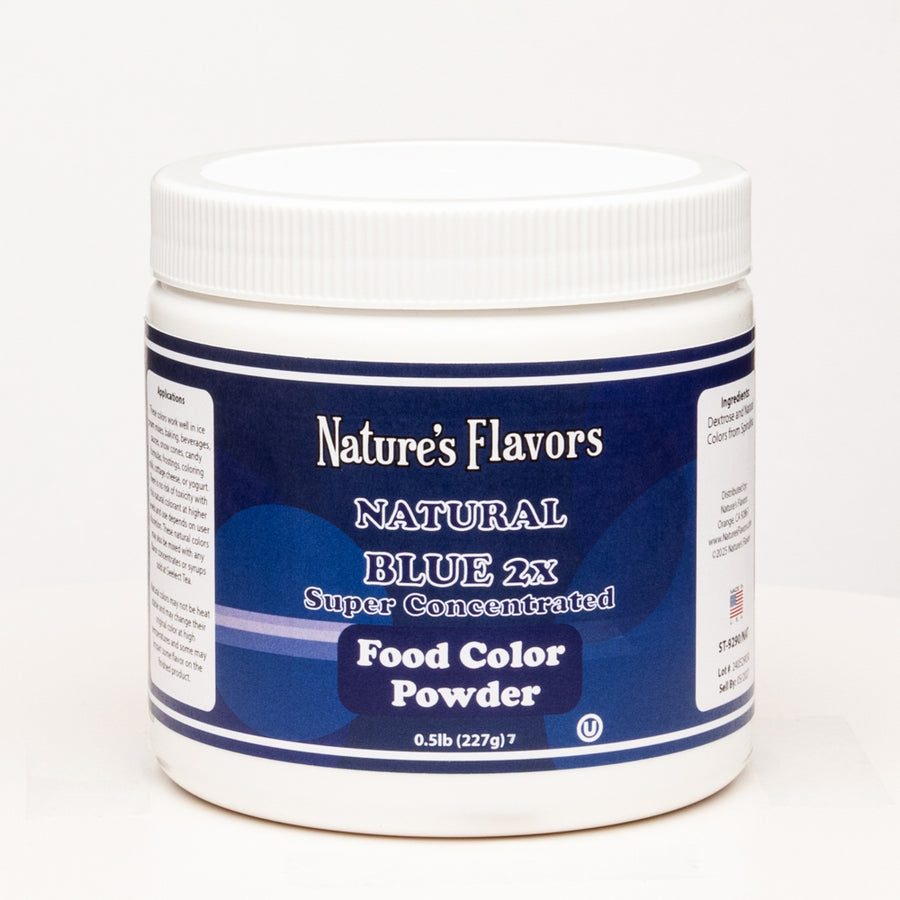



The Complete Guide to Natural Blue Food Coloring
 Blue is the rarest color in the natural food world — and that rarity is exactly what makes natural blue food coloring so fascinating, and so valuable. Unlike red, yellow, or green, a true natural blue food colour derived from plants is notoriously difficult to source, stabilize, and scale. Yet demand has never been higher. Food manufacturers and home bakers are moving away from synthetic dyes in growing numbers, and that shift has put natural blue food dye squarely at the center of the clean-label conversation.
Whether you're a food manufacturer reformulating a product line, a pastry chef searching for natural blue food coloring for icing or frosting, or a curious consumer who's ever wondered "is there a naturally blue food?" — this guide covers everything you need to know about natural blue food color: its sources, its science, its applications, and where to find the real thing.
Is there a naturally blue food? Yes — but it's rare
Many people are surprised to learn that naturally blue food actually exists. The blue and violet pigments found in plants and algae belong primarily to two compound families: anthocyanins and phycocyanin. These are the molecules behind every natural blue food colorant on the market today.
So are there any natural blue foods? Absolutely. Here are the most recognized blue foodstuffs found in nature:
-
Blueberries — perhaps the most familiar of all blue foods natural to North America
-
Blue corn — a staple of Southwestern U.S. cuisine with a deep indigo hue
-
Butterfly pea flower (Clitoria ternatea) — one of the most potent natural blue food colorants available commercially
-
Spirulina — a blue-green algae that produces vivid blue food dye at commercial scale
-
Indigo — historically used as a blue food dye in certain Asian cuisines
-
Purple sweet potato — contributes to the blue-violet range in many applications
The challenge is that many of these sources are pH-sensitive, heat-unstable, or low in yield — which is precisely why natural blue food in pigment form has historically been so difficult to scale. Is there a blue food that's easy to work with at industrial volumes? Until recently, not really. That's changed.
What is blue food coloring made of?
This is one of the most common questions we receive: what is blue food coloring made of? The answer depends entirely on whether you're talking about synthetic or natural versions.
Synthetic blue food dye
Conventional blue food dye is made from petroleum-derived compounds. The two most widely used are FD&C Blue No. 1 (Brilliant Blue FCF) and FD&C Blue No. 2 (Indigo Carmine). When people ask for the blue food coloring number, these FDA designations are what they're referencing. The blue food coloring name "Brilliant Blue" might sound appealing, but for brands pursuing clean-label positioning, these synthetic options carry growing regulatory and consumer perception risk.
What is blue food dye made of when it's natural?
A natural blue food colorant must be derived from a plant, mineral, or other naturally occurring source without synthetic chemical processing. Today, two sources dominate:
Spirulina extract (phycocyanin) is the gold standard among blue food coloring ingredients. Phycocyanin is a water-soluble protein-pigment complex extracted from spirulina algae, producing a brilliant, vivid blue. It's approved in the U.S. and EU, and it's the reason you're increasingly seeing organic blue food coloring on shelves with a simple, clean label — just "spirulina extract." It's the primary ingredient in our natural blue food dye collection.
Butterfly pea flower extract is derived from the Clitoria ternatea plant and produces an intense, pH-reactive blue. It's among the most exciting blue food colouring ingredients in the natural space right now, though its behavior in baked goods requires careful formulation.
What makes blue food coloring from these sources special is the combination of visual intensity and label transparency. Your customers can read and recognize the ingredient name. That matters enormously in today's market.
Natural vs. synthetic: why the blue food dye conversation has changed
The blue food dye landscape has shifted dramatically over the past decade. Regulatory pressure, clean-label consumer demand, and growing scrutiny of synthetic dyes have accelerated the pivot toward blue food colouring natural alternatives.
For food manufacturers, this isn't just a health issue — it's a business continuity issue. Brands already using natural blue food color are ahead of regulatory trends. For direct-to-consumer buyers, the shift is even more immediate. Today's shoppers read ingredient labels, and a blue food coloring derived from spirulina tells a fundamentally different story than one identified only by a five-digit synthetic dye number.
Forms of natural blue food coloring
Blue food coloring powder
Blue food coloring powder (also spelled blue food colouring powder in Commonwealth markets) is ideal for dry applications: spice blends, dry baking mixes, confectionery coatings, and protein powders. Blue food powder derived from spirulina is especially popular here because of its excellent color intensity per gram and long shelf life in low-moisture environments.
Liquid blue food coloring
Liquid formats offer ease of incorporation into beverages, sauces, dairy products, and confections. They're the most common format for home use and small-batch production, and often the right call for beverage and RTD applications where blue food color needs to disperse evenly.
Concentrated blue food coloring dye
For manufacturers requiring precise dosing and minimal impact on moisture content, concentrated blue food coloring dye formats deliver high color strength at low usage rates. These are typically standardized to a set phycocyanin or anthocyanin concentration — a critical requirement for batch-to-batch color consistency in commercial production.
Application guide: using natural blue food coloring
Natural blue food coloring for icing and frosting
Getting a true, stable blue with natural blue food coloring for icing is one of the trickier challenges in natural decorating. Standard buttercream is alkaline-leaning, which can cause butterfly pea flower extracts to shift toward purple or gray. Spirulina-based natural blue food coloring for frosting tends to be more stable in this context, particularly in dairy-fat environments. Avoid high-acid additions near your blue colorant — citrus juice or zest will push the hue toward pink or purple.
Dark blue food coloring vs. light blue food coloring
Achieving dark blue food coloring naturally requires significantly higher pigment concentrations. Dark blue food dye from spirulina can be achieved, but may impart a subtle earthy flavor note at high usage rates — something formulation teams should plan for. Light blue food coloring shades are much easier to achieve cleanly and require lower pigment loads with virtually no off-note risk.
Blue foods natural: a broader look at blue in food culture
Beyond colorants, blue foods natural have a rich cultural history. Natural blue ingredients have appeared in traditional cuisines across Asia, Central America, and the Pacific Islands for centuries. Some notable examples:
-
Blue corn tortillas and chips — made from heirloom varieties of blue foods natural to the American Southwest
-
Ube — a purple yam from the Philippines producing vivid blue-violet hues in desserts
-
Indigo milk cap mushrooms — among the only naturally blue fungi
-
Borage flowers — small edible blue food blooms used as garnishes in European cuisine
-
Butterfly pea flower tea — a vivid blue food beverage central to Southeast Asian culture
The popularity of these blue foodstuffs reflects something real: consumers want their food to tell a story. Natural blue tells a compelling one.
Sourcing natural blue food color: what to look for
Not all natural blue food color products are created equal. Here's what to evaluate when sourcing for commercial or consumer use:
For food manufacturers: standardized phycocyanin content with a certificate of analysis; heat stability data relevant to your process; a pH compatibility profile for your specific formulation; full regulatory documentation for your target markets; and organic blue food coloring certification if required.
For direct-to-consumer buyers: ingredient transparency (look for the actual source name — "spirulina extract" or "butterfly pea flower extract"); format suitability (blue food coloring powder vs. liquid); usage rate guidance; and confirmation that the supplier offers both light blue food coloring and dark blue food coloring intensities.
Our natural blue food color collection
At [Your Flavor House Name], our blue food color collection is built around one principle: uncompromising quality from source to shelf. Whether you're a manufacturer scaling a new product line or a home baker looking for a reliable natural blue food dye, we have a format designed for your application.
-
Spirulina blue liquid extract — our flagship natural blue food colorant for beverages and dairy, standardized for phycocyanin content
-
Butterfly pea flower powder — premium blue food coloring powder for dry mixes and specialty confections
-
Organic blue food coloring liquid — USDA-certified organic blue food coloring for fully compliant formulations
-
Dark blue concentrate — ultra-high pigment loading for dark blue food coloring applications
-
Light blue blend — pre-diluted for pastel light blue food coloring, including natural blue food coloring for icing
Explore our natural blue food color collection
Natural & organic blue food coloring — available in liquid, powder, and concentrated formats for food manufacturers and home bakers.
→ Shop Now | → Request a free sample | → Talk to a formulation specialist
Frequently asked questions
Is there a naturally blue food?
Yes. Blueberries, blue corn, butterfly pea flowers, spirulina, and indigo milk cap mushrooms are among the naturally blue foods found in nature. Most plant-based blue pigments come from anthocyanins or phycocyanin.
What is blue food coloring made of?
Synthetic versions are made from petroleum-derived compounds (FD&C Blue No. 1 or No. 2). Natural versions are made from spirulina extract or butterfly pea flower extract — the two primary blue food coloring ingredients in clean-label formulations today.
What is blue food dye made of when labeled "natural"?
A natural blue food dye must be derived from a natural source. In practice this almost always means spirulina (phycocyanin) or butterfly pea flower (anthocyanins). Both are recognized as safe and approved in the U.S., EU, and most global markets.
What is the blue food coloring number?
In the U.S., the blue food coloring number for synthetic dyes is FD&C Blue No. 1 (Brilliant Blue FCF) and FD&C Blue No. 2 (Indigo Carmine). Natural options like spirulina extract don't carry an FD&C number — they're listed by ingredient name.
What is the blue food coloring name for the natural version?
The blue food coloring name you'll see on labels for natural versions is typically "spirulina extract," "spirulina concentrate," or "butterfly pea flower extract."
What colors make blue food coloring?
Blue is a primary color — you cannot mix other colors to produce it. What makes blue food coloring blue in nature is phycocyanin (from spirulina) or anthocyanins at neutral-to-alkaline pH (from butterfly pea flower, red cabbage, or elderberry).
Is there any natural blue food that's purely plant-derived?
Yes. Butterfly pea flower, blueberries, blue corn, and spirulina are all 100% natural. In commercial food coloring, spirulina extract is the most widely used natural blue food color for its stability, yield, and clean regulatory status.
The bottom line on natural blue food coloring
Blue has always been the hardest color to achieve naturally — but it's no longer out of reach. With advances in spirulina extraction and the growing availability of butterfly pea flower, natural blue food coloring is now a commercially viable, clean-label solution for manufacturers and bakers alike.
Whether you need blue food coloring powder for a dry mix, a liquid blue food dye for a beverage, a concentrated dark blue food dye for confectionery, or a gentle light blue food coloring for a pastel frosting, the natural options today are genuinely excellent. The brands that make the switch now will be well-positioned as clean-label expectations continue to rise.
The era of petroleum-derived blue food dyes is fading. The era of natural blue food color — beautiful, plant-derived, and transparent on the label — is here.